Case:
Background & Challenge
A customer in the carbide industry contacted PF System regarding a new filtration system for its process. One of the key requirements was the ability to isolate individual filter sections for maintenance and service while allowing the remainder of the system to remain in operation.
The customer already had a filtration system supplied by another vendor where section isolation had been partially implemented. However, the solution only included dampers on the filter inlet side, meaning that negative pressure was still present in the supposedly isolated section. As a result, maintenance work could not be carried out safely or effectively.
PF System’s Solution
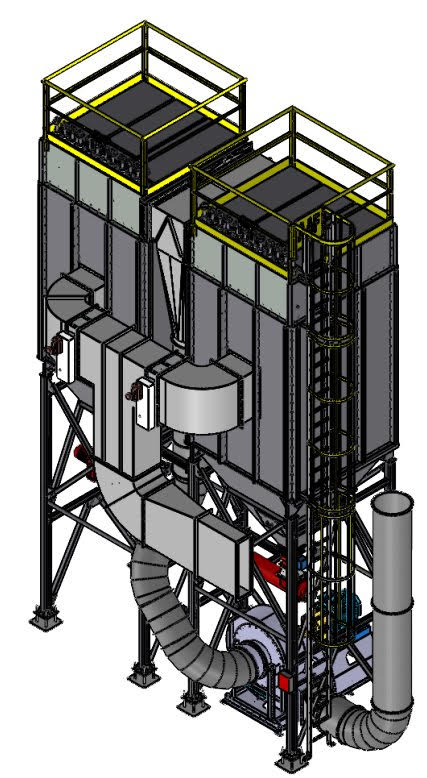
PF System conducted a detailed review of the application and designed a new filtration system with a properly engineered section isolation concept.
The system was equipped with the necessary isolation functions to completely separate individual filter sections from the process vacuum during maintenance operations. This allows service work to be performed on one section while the remaining filter sections continue operating.
In addition to supplying the new filtration system, PF System also upgraded the customer’s existing filter installation to correct the previous design shortcomings and enable true sectional isolation.
Results
Customer Value
By implementing a properly engineered sectional isolation solution, PF System significantly improved the maintainability and availability of the customer’s filtration systems. The customer received both a new filtration installation and an upgraded existing system, enabling safer maintenance procedures, reduced downtime, and greater operational flexibility throughout the production process.