Case:
Background & Challenge
Following a dust emission measurement from a melting furnace, the customer discovered that emissions exceeded the limits established by local environmental authorities. Although the exceedance was relatively small, corrective action was required to ensure ongoing regulatory compliance.
The challenge was further complicated by the high flue gas temperatures generated by the process, reaching approximately 550°C. The customer required a solution that would achieve compliance while maintaining a reasonable investment and operating cost.
PF System’s Solution
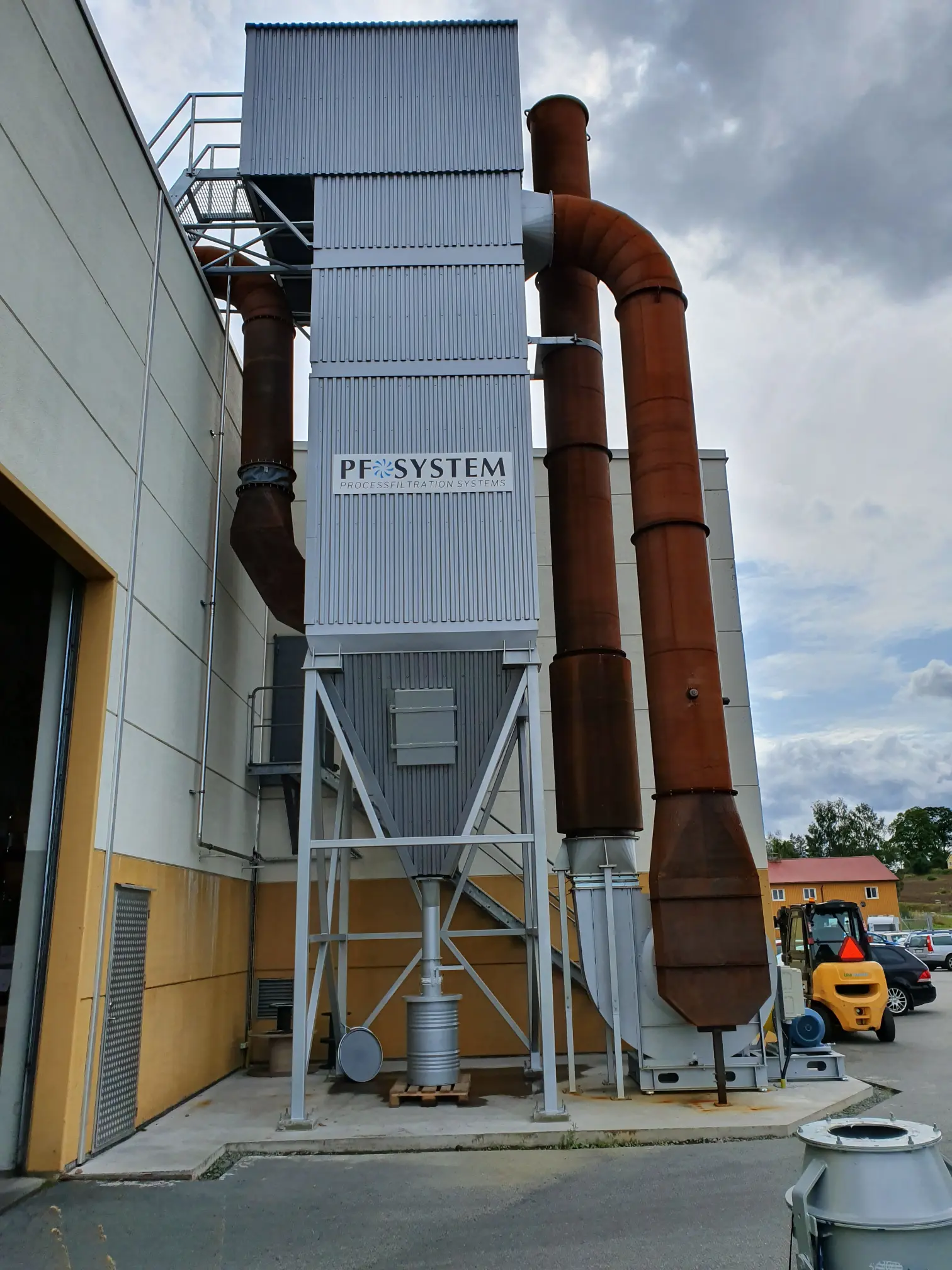
PF System carried out a detailed process evaluation and developed a cost-effective filtration solution based on a bag filter system.
Since the bag filter is designed for operating temperatures up to 260°C, a cooling system was engineered to dilute the hot flue gases with ambient air before entering the filter housing. Airflow simulations were performed to accurately size and optimize the cooling arrangement.
The system was equipped with temperature sensors and automatically controlled cooling air dampers. This allows the cooling airflow to continuously adjust according to actual process temperatures, ensuring that only the necessary amount of dilution air is introduced.
Results
Customer Value
By combining advanced airflow simulations with intelligent temperature control, PF System delivered a solution that met both environmental compliance requirements and operational objectives.
The result was a robust filtration system that effectively reduces dust emissions, ensures regulatory compliance, and optimizes energy usage by introducing only the amount of cooling air required for safe operation.